
Master Of Pottery Version 1.0 Launch Notes
The career you know, plus public rooms for tokens and comments in the hall.
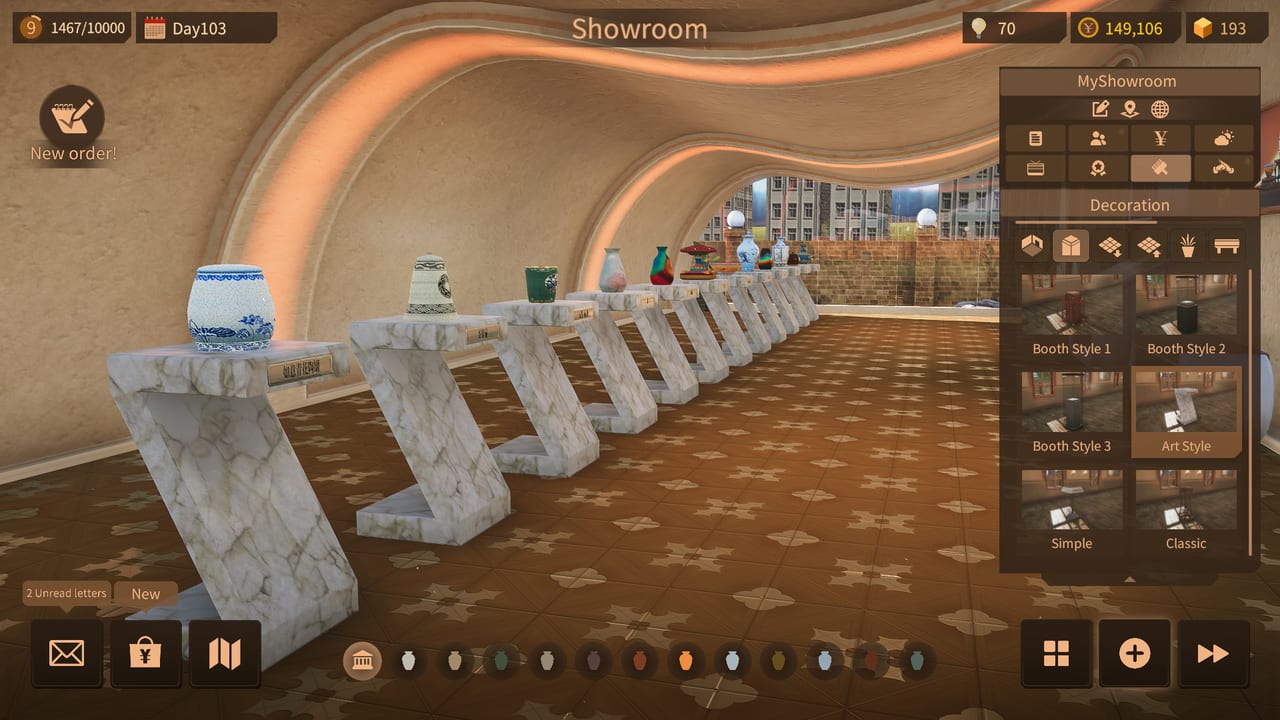
Version 1.0 of Master Of Pottery is the full release. AZGames took the game out of Early Access on 10 September 2026, a little under seven years after the 11 November 2019 Early Access launch. The 1.0 week is not a sequel and not a wipe. It is the career, the kiln, the store, the mailbox, the warehouse, and the display room, with two hall-and-network features promoted into the finished product: online tokens from creating rooms, and real-time tourist comments during exhibitions.
If you are installing for the first time, treat 1.0 as the game. Follow Getting Started. If you already have an Early Access save, boot it. Your pots, yen, booths, and apprentices are the 1.0 save.
What 1.0 means on Steam
Steam now shows 10 September 2026 as the release date and keeps 11 November 2019 as the Early Access date. The Early Access badge is gone. Reviews around launch sit Overwhelmingly Positive, about 97 percent. The list price is about $5.99 / ¥700, with a short introductory discount on the launch window. Languages remain English, Simplified Chinese, Japanese, and Italian. Windows only, Steam Deck Playable.
AZGames’ original Early Access note said the then-current build already had a career model, a complete ceramic production process, store, mailbox, warehouse, and a room for displaying ceramics. That list is still the spine. 1.0 is the studio saying those systems, plus the later apprentice, order, tea house, and exhibition work, are the finished game.
Rooms and online tokens (8 September 2026)
A regular update dated 8 September 2026 added a new way to obtain online tokens. You earn tokens continuously by creating rooms. Public rooms earn faster than private rooms. That is the whole official note, and it is the one to remember:
- Create a room if you want tokens.
- Prefer public if you want the faster rate.
- Private still earns; it is just slower.
Tokens are for the online layer. They do not replace yen in the career store. They do not grade a pot. They do not skip the kiln. Steam already listed multi-player and online interactivity; 1.0 makes the room-and-token loop explicit. The core day is still throw, fire, paint, exhibit. After the hall closes you can sit in a room and collect tokens. You can also ignore rooms and play the career. Both are supported. The workshop day is still a solo career, and the rooms are already in the build.
Real-time tourist comments
A regular update in the 1.0 season added real-time tourist comments during exhibitions. Visitors react to the works on the floor. Those reactions are a hint: you can tell earlier which piece may draw a purchase request. That is a quality-of-life read on exhibition heat, not a new scoring system.
Use comments the way you use heat. If tourists keep talking about one teapot, leave it on a booth. If a piece is silent, rotate it. Purchase mail after the show is the old system; comments are the live tell. They do not replace ticket pricing or ads. They make the hall less of a black box.
A July 2026 regular update already described tourist comments. The September notes sit on top of that work. For wiki purposes, treat live comments as part of the 1.0-era hall, whether the first steam of them arrived in July or September. They are in the build you launch after 1.0.
What did not change
The production pipeline is still throwing, drying, preheating, high-temperature firing, painting, and glazing. The kiln still wants an inside-out fire. SSS still wants late materials, stroke count, parts up to 50, and style match. Inspiration still starts at 100 a day. Apprentices still wait on reputation 500. The twelve Steam achievements did not grow a thirteenth.
Career, kiln, store, mailbox, warehouse, and display room are the Early Access pillars that 1.0 kept. If a guide from 2020 told you how to export a .pottery file into the collection folder, that workflow is still a community trick, not a 1.0 headline. If a guide told you to buy newspaper ads and extra booths, that is still the hall.
DLC did not get folded into 1.0 for free. Suzhou Garden, the four pattern packs, and the free soundtrack remain separate Steam apps. See the DLC pattern packs page for dates and prices. 1.0 does not require DLC. DLC does not require a new 1.0-only installer beyond owning the base game (Suzhou Garden still wants 0.9.9f or later, which 1.0 satisfies).
How to play the first week of 1.0
- Confirm the install is the 1.0 branch, not a leftover beta depot.
- Throw a starter piece, fire it, open the hall. Grand opening still works the same.
- After an exhibition, read tourist comments and note which work they liked.
- Create a public room if you want tokens; leave it if you do not.
- Spend yen on throwing tools and parts before panic-buying every pattern.
- Mail, warehouse, and store are where they were. Check mail so apprentice requests do not rot.
Support is still azgames@foxmail.com. Patch notes still post on the Steam news feed. This page will grow if AZGames ships a 1.1 with a new systems paragraph. Until then, 1.0 is the name for “the Early Access game, finished, with rooms and comments.”
The launch week discount ends; the firing minigame does not. Put the pot in the kiln from the inside out, then go look at what the tourists are saying. That is the 1.0 loop in one line, and it is already on your machine.
Frequently Asked Questions
Quick answers about throwing, firing, and running your showroom.
Is version 1.0 out?
Yes. Master Of Pottery left Early Access on 10 September 2026. The full release is already on Steam.
Do I need a new save?
No. Early Access careers keep their works, yen, booths, and apprentices. 1.0 adds rooms, tokens, and live tourist comments on top of the same career.
How do online tokens work?
Create rooms to earn tokens continuously. Public rooms earn faster than private rooms. Tokens feed the online layer; career store prices are still yen.
What are tourist comments for?
During exhibitions, visitors react to pieces. Use the comments as an early signal of which work may get a purchase request, then keep that work on a booth.
Did the kiln or SSS rules change?
Not in the 1.0 notes. Inside-out firing, late materials, stroke count, parts, and style match still decide grade. 1.0 did not skip the kiln.
Does 1.0 include online rooms?
Yes. Steam lists multi-player, and 1.0 public and private rooms are live. The workshop day is still a solo career. Both statements are true.